
This article is part of our Muscle 40+ Series. See all guides here.
You’ve hit your 40s. Work is demanding, sleep isn’t perfect, and time is always short. Still, you want to stay healthy, strong, and active — not just for today, but for the years ahead.
But where do you start? Should you focus on strength training or cardio?
This isn’t just a gym debate — it’s a real decision that shapes how you age. Choosing the right approach to strength vs cardio after 40 can impact your energy, your joints, and your long-term fitness.
Quick Summary (TL;DR)
- 🏋️♂️ After 40, training feels different — recovery slows down, hormones shift, and daily stress makes energy harder to manage.
- 💪 Strength training builds muscle, protects joints, supports hormones, and keeps your body capable as you age.
- ❤️ Cardio keeps your heart, lungs, and metabolism strong — it’s not about running marathons, but staying active and resilient.
- ⚖️ The best results come from balance: lift 2–3 times a week and do cardio 2–3 times — consistency beats extremes.
- ⚡ Most problems come from doing too much, skipping recovery, neglecting nutrition, or relying only on one type of training — strength and cardio work best together.
- ⚠️ If pain, fatigue, or stiffness don’t go away, rest and check with a doctor before pushing harder.
Simple Overview
Why This Decision Feels Different After 40
Before choosing between strength or cardio, it’s important to understand how your body — and your lifestyle — change after 40. The way you trained in your 20s may no longer serve you well. Here’s why.
Changing Life Priorities
Life in your 40s brings new challenges. Sleep isn’t always great, work can be demanding, and family responsibilities often take the lead. The time and energy you once gave fully to training may now be split across many areas of life.
Hormonal Shifts and Recovery Changes
Around the age of 35, testosterone levels begin to decline gradually. By your 40s, this drop often becomes more noticeable. Recovery also becomes slower with age. You may no longer bounce back as quickly after a workout, and training too hard without proper rest can lead to fatigue or injury.
Joint Health and Injury Prevention
As you get older, your joints naturally experience more stress and gradual changes. Cartilage thins out, flexibility decreases, and past injuries may start to cause problems again. These changes are normal, but they affect how your body responds to training.
That doesn’t mean you should stop training hard — but it does mean you need to train smarter. That’s why proper warm-ups, mobility work, and solid form matter more than ever.
What Each Type of Training Actually Does
Strength training and cardio both offer serious benefits — especially for men over 40. While some effects may feel similar, each method supports your health in different, complementary ways. Let’s look at what each one really delivers.
Strength Training: Key Benefits
Strength training helps you stay physically capable and metabolically active as you age. It’s not about bodybuilding — it’s about keeping your body strong, mobile, and resistant to decline.
Main benefits of strength training:
- Builds and maintains muscle mass
- Increases metabolic rate (you burn more calories at rest)
- Strengthens bones and joints
- Supports insulin sensitivity and blood sugar control
- Supports healthy testosterone levels
- Improves posture and reduces back pain
- Enhances balance, coordination, and fall resistance
- Supports confidence and mental clarity
Strength training is powerful, but only when done safely — here’s my take on how men over 40 can lift smart and protect their joints.
Cardio Training: Key Benefits
Whether it’s walking, swimming, cycling, or any aerobic activity — cardio helps keep your internal systems running well and supports your overall vitality.
Main benefits of cardio training:
- Lowers resting heart rate and blood pressure
- Improves cardiovascular endurance (VO2 max)
- Supports arterial health
- Reduces visceral fat and supports healthy body composition
- Helps regulate cholesterol and reduce heart disease risk
- Supports cognitive performance, mood, and emotional resilience
- Improves oxygen use and breathing efficiency during effort
For men over 40, resistance and cardio training is a foundation for long-term health — not a luxury.
Which One Should You Prioritize?
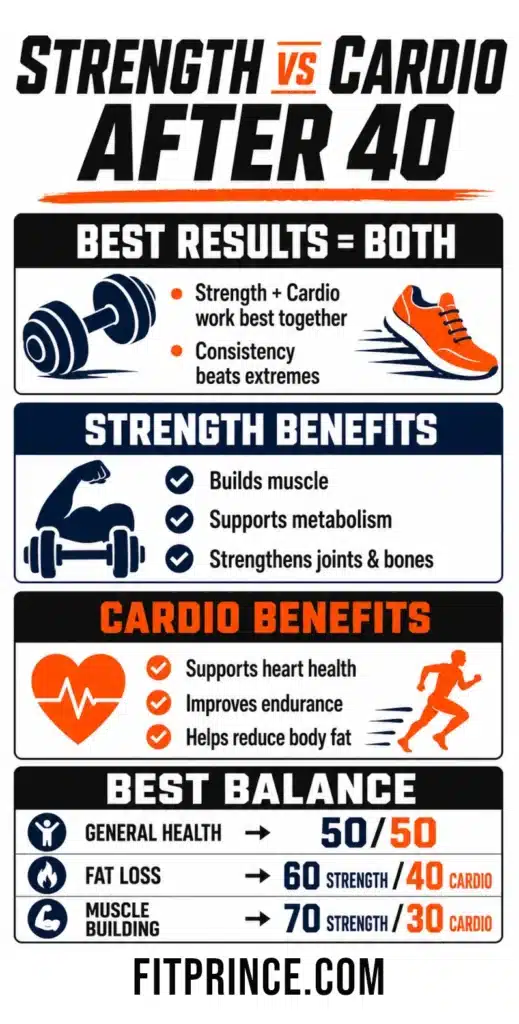
The good news? You don’t have to choose only one. In fact, the best approach often involves combining both types of training in a way that fits your goals, fitness level, and lifestyle.
The World Health Organization recommends that adults engage in at least 150 minutes of moderate-intensity activity or 75 minutes of vigorous-intensity activity per week — or a combination of both. Additionally, at least two muscle-strengthening sessions per week are recommended. These guidelines represent the minimum needed to maintain health, not an upper limit.
Unfortunately, many people fall short. According to 2022 data from the United States:
- Only 25.3% of adults meet both the aerobic and muscle-strengthening guidelines.
- Among adults aged 45–64, the compliance rate drops to 20.4%.
- By age 65 and over, it declines further to just 14.4%.
So where should you focus — strength or cardio? That depends on your goals.
Here’s a practical guide to help you prioritize.
For General Health and Fitness
50% strength, 50% cardio. A balanced approach helps maintain muscle, support heart health, manage energy, and promote long-term consistency. This is the best starting point for most men over 40.
For Body Fat Loss
60% strength, 40% cardio. While cardio burns more immediate calories and accelerates fat loss, strength training plays a crucial role in preserving muscle mass and maintaining metabolism during caloric restriction. The most effective approach combines both—cardio for immediate fat burning, strength training to protect muscle and ensure lasting results.
For Muscle Building
70% strength, 30% cardio. Building muscle requires progressive overload through resistance training. Cardio supports recovery, circulation, and heart health, but shouldn’t dominate your weekly schedule when muscle gain is the primary objective.
Speaking honestly, this is how I train myself. I’ve always prioritized strength and muscle-building, and I add cardio—both easy and more intense—on my non-lifting days. It’s a balance that works for me.
Here’s a full guide on how much muscle you can build after 40.
For Cardiovascular Health and Stamina
60% cardio, 40% strength. Improving heart health, endurance, and blood pressure requires consistent aerobic training. Cardio increases VO2 max and supports vascular function. Strength training maintains joint health, muscle tone, and metabolic function while complementing—not replacing—cardiovascular work.
These percentages reflect training focus rather than exact time allocation. Consider them guidance for weekly routine prioritization, not rigid minute-by-minute breakdowns.
Also include regular mobility work, and as you age — especially after 65 — add balance-focused exercises to reduce fall risk.
Not sure where to start? 👉 Grab my free gym workout program designed for men over 40.
Strength + Cardio: How to Combine Them Without Burning Out
Combining strength and cardio training can deliver great results — but only if done with care. Without a plan, it’s easy to overtrain, stall your progress, or feel constantly fatigued.
Here’s how to integrate both training styles safely and effectively.
General Guidelines
- Start simple: Begin with low-intensity cardio like brisk walking, Nordic walking, or cycling. Add running or higher-intensity options like HIIT only when your body is ready. If you use HIIT, start with one short, controlled session per week.
- Lift first if strength is your goal: If strength and muscle are your main goals, do not place hard cardio right before or right after lifting. Strength training and cardio workouts are usually better on separate days. If you need to do both on the same day, lift first and leave several hours between sessions.
- Increase slowly: Progress step by step. Trying to do too much too soon can lead to fatigue, joint discomfort, and setbacks.
- Use deload weeks: Every 4–6 weeks, consider reducing training volume or intensity, especially if fatigue, joint discomfort, or poor performance starts to build up.
- Recover well: Eat well, sleep 7–9 hours per night, and don’t ignore rest days. After 40, your body needs more time to repair.
- Watch your balance after heavy training: After very hard lower-body or full-body workouts, balance and coordination may feel temporarily reduced, especially in older adults. Avoid risky balance, agility, or unstable-surface exercises when you are heavily fatigued.
- Keep moving well: Include mobility work on most days to support your joints, improve flexibility, and maintain better movement quality.
Sample Weekly Layout (Beginner-Level)
- Monday: Full-body resistance + mobility/stretching
- Tuesday: Low-intensity cardio (walking or cycling)
- Wednesday: Upper body resistance + mobility/stretching
- Thursday: Rest
- Friday: Low-intensity cardio
- Saturday: Lower body resistance + mobility/stretching
- Sunday: Rest
Mobility drills can be done alongside strength days. If you prefer to start with a cardio focus, flip the ratio: do three cardio sessions per week and two strength workouts (upper and lower). Adjust the balance as needed based on your goals and recovery.
For a step-by-step program that fits this schedule, take a look at my joint-friendly dumbbell routine designed for men over 40.
Common Mistakes Men Over 40 Make When Balancing Strength and Cardio
Relying Only on Cardio for Fat Loss
Many men focus solely on cardio to lose weight. But without strength training, this leads to faster muscle loss, slower metabolism, and plateaus. Cardio is valuable — but include 2–4 resistance training sessions weekly to maintain muscle and metabolic health.
Treating Strength and Cardio as Unrelated
When cardio and strength are not planned together, they can start working against each other. One type of training may interfere with the benefits of the other if timing, intensity, and recovery are ignored. Instead, alternate focus: dedicate weeks or training blocks to strength while maintaining light cardio, and reverse when focusing on conditioning.
Overdoing High-Intensity Cardio
Believing more intensity equals better results, some men do HIIT multiple times a week. But as recovery slows with age, too much HIIT leads to fatigue, joint pain, and reduced strength gains. Limit it to 1–2 short sessions weekly. Use low-intensity cardio to support fat loss and heart health without draining recovery.
Ignoring Mobility Work
Desk jobs and daily stress cause stiffness in the spine and hips, limiting movement quality. Just 5–10 minutes of mobility drills before workouts can reduce injury risk and improve form. Weekly stretching or yoga can also help maintain flexibility and joint function.
A set of simple mobility drills can loosen stiff joints after 40 and make your workouts safer.
Not Tracking Progress
Training without any form of tracking makes progress random and inconsistent. You don’t need complicated apps — simple notes on sets, reps, distance, or heart rate are enough. Track what matters to you so you can measure what’s working and adjust accordingly.
Skipping Recovery
Going hard every day may feel productive, but at 40+, it can backfire fast. Lack of recovery leads to poor sleep, low testosterone, increased inflammation, and stalled results. Take 1–2 full rest days each week and plan a deload every 4–6 weeks to let your body recharge.
Misaligned Nutrition
Your diet shouldn’t be separate from your training — or your age. What you eat needs to reflect your goals, your workouts, and the way your body changes over time. For example, it’s hard to build muscle if you don’t eat enough protein — especially after 40. And it’s nearly impossible to lose fat if you reward every workout with a late-night binge. Match your daily calories, protein, and meal timing to what you’re training for. Don’t let poor fueling slow down your results.
Most mistakes come from treating a 40-year-old body like it’s still 20. Recovery, mobility, and nutrition aren’t extras — they’re core parts of your progress. Respect them as much as your sets and reps.
Frequently Asked Questions
Is it too late to start lifting weights after 40?
Absolutely not. Many men begin strength training in their 40s, 50s, or even 60s and see excellent results. Progress may be slower than in your twenties, but you can still build muscle, gain strength, and improve energy, posture, and long-term health.
How much cardio should I do if I lift weights three times a week?
Aim for at least 150 minutes of moderate or 75 minutes of vigorous cardio per week. You can also combine intensities. Start with lower-impact options and increase gradually as your conditioning improves.
Can I do HIIT right after strength training, or should I separate them?
It is usually better to separate them. After 40, doing HIIT right after heavy strength training is generally not recommended because fatigue can reduce training quality, increase recovery demands, and raise the risk of poor form or injury. If you do both on the same day, leave at least several hours between sessions — and avoid doing this too often.
My joints feel sore after lifting — should I stop training?
Not always, but do not ignore joint pain. Start by reducing the weight, checking your technique, and switching to more joint-friendly exercises if needed. Give sore joints more recovery time before heavy sessions. For sharp, worsening, or persistent pain that does not improve with lighter training and rest, speak with a doctor or physical therapist.
How do I know if I’m overtraining?
Look out for signs like low energy, poor sleep, lack of motivation, or joint pain. These may point to poor recovery. Prioritize sleep, review your training volume, and consider taking a deload week if symptoms continue.
Do my 7,000–10,000 daily steps count toward cardio goals?
Partially — it depends on how intense the walking is and your current fitness level. Casual steps don’t fully meet cardio guidelines. To count, steps should be at a brisk pace (100+ per minute). That said, even slower walking can offer cardiovascular benefits for beginners or those with excess weight.
If I run five times a week, do I still need 10,000 steps daily?
Not necessarily. Your runs cover most cardio needs, but long periods of sitting still pose separate risks. On rest days, aim for at least 5,000 casual steps and get up briefly every hour to maintain joint health and reduce lower back tightness.
If you’re over 40 and unsure how to begin, 👉 download my free strength training plan today.
Your Next Steps
The strength vs cardio debate after 40 isn’t about picking sides — it’s about choosing wisely. Your body has carried you for decades, and now it’s asking for a more thoughtful approach.
Whether your goal is to build muscle, lose fat, or simply feel strong and energetic, a balanced combination of strength and cardio will always beat one-dimensional training.
Start where you are — not where you think you should be.
Haven’t exercised in years?
Begin with walking and simple bodyweight movements.
Already active?
Take a closer look at your routine. You might find opportunities to improve balance, mobility, or recovery — and feel even better for it.
References
View sources (8)
- Cardiovascular Benefits of Endurance Training in Seniors: 40 is not too Late to Start.
https://pubmed.ncbi.nlm.nih.gov/27116349/ - Comparison of concurrent, resistance, or aerobic training on body fat loss: a systematic review and meta-analysis.
https://pubmed.ncbi.nlm.nih.gov/40405489/ - Increase the proportion of adults who do enough aerobic and muscle-strengthening activity — PA-05.
https://odphp.health.gov/healthypeople/objectives-and-data/browse-objectives/physical-activity/increase-proportion-adults-who-do-enough-aerobic-and-muscle-strengthening-activity-pa-05 - Physical activity.
https://www.who.int/initiatives/behealthy/physical-activity - Physical activity and risk of cardiovascular disease–a meta-analysis of prospective cohort studies.
https://pubmed.ncbi.nlm.nih.gov/22470299/ - Resistance training is medicine: effects of strength training on health.
https://pubmed.ncbi.nlm.nih.gov/22777332/ - The Effect of Resistance Training on Bone Mineral Density in Older Adults: A Systematic Review and Meta-Analysis.
https://pmc.ncbi.nlm.nih.gov/articles/PMC9222380/ - The Role of Exercise-Induced Cardiovascular Adaptation in Brain Health.
https://pubmed.ncbi.nlm.nih.gov/26196870/