This article is part of our Fat Loss 40+ Series. See all guides here.
For many men, belly fat seems harmless — just a natural part of aging. But after 40, it becomes one of the most serious warning signs for long-term health.
As hormones change and muscle mass drops, fat starts to collect around the waist. What looks like a simple change in shape often hides deeper risks.
Understanding why belly fat is dangerous isn’t about fear — it’s about awareness. When you know what’s happening inside your body, you can take smarter steps to stay strong, healthy, and energetic in the years ahead.
Quick Summary (TL;DR)
- 🧱 There are two types of belly fat: subcutaneous fat (soft, the one you can pinch) and visceral fat (hidden around your organs). Visceral fat is the one that drives most health risks.
- 🔄 After 40, belly fat increases due to genetics, muscle loss, lifestyle changes, and hormonal shifts.
- ❤️ A growing waistline raises major risks: all-cause mortality, heart disease, type 2 diabetes, high blood pressure, stroke, fatty liver, low testosterone, certain cancers, and chronic pain.
- 📏 Waist measurements predict danger better than body weight. Risk increases above 94 cm (37″), and the high-risk zone starts at 102 cm (40″). Waist-to-height ratio is even more accurate—under 0.5 is healthy; above 0.5, the risk starts to increase.
- 🚶 Early warning signs show up in daily life: getting winded fast, tightness in the midsection, heavy snoring, back pain, and aching joints.
- 🧠 Most common myths are wrong: crunches don’t burn belly fat, supplements can’t melt fat, healthy carbs aren’t the enemy, and even “thin” men can have dangerous visceral fat.
The Two Types of Belly Fat—And Why One Kills You
Subcutaneous Fat — The One You Can Pinch
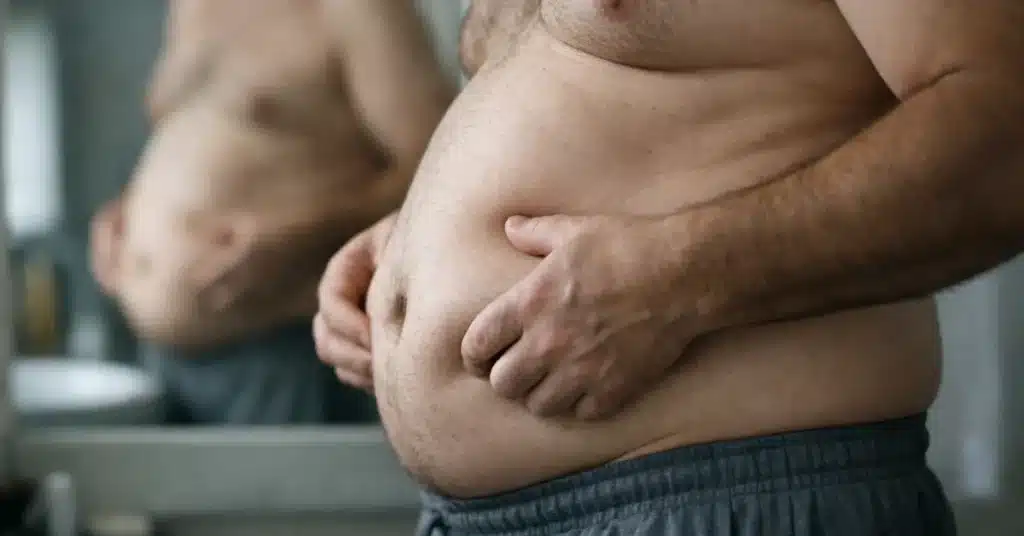
Subcutaneous fat sits right under your skin. It’s the soft layer you can pinch on your belly or love handles—the one that gives your stomach a looser, softer look.
Men often notice it building up around the lower abdomen and sides, especially after long hours of sitting or when activity levels drop.
This fat mainly acts as energy storage and insulation. Everyone has some, and in moderate amounts it’s not harmful. In fact, subcutaneous fat can even protect your body by cushioning against bumps and helping regulate temperature.
For men over 40, a large amount of subcutaneous abdominal fat can still signal poor metabolic health. It can also put extra strain on your joints and heart when it builds up excessively.
Visceral Fat — The Hidden Kind Inside
Visceral fat (also called intra-abdominal fat) sits deep inside your abdomen, underneath the layer of subcutaneous fat. You can’t pinch it because it wraps around your organs—the liver, intestines, and pancreas.
Men are naturally more prone to storing fat in this visceral area than women. Even if you look relatively lean, that doesn’t always mean you have little visceral fat. Some men with a normal weight still carry excess fat around their organs, especially if they’ve lost muscle mass or spend most of the day inactive.
Unlike the soft, jiggly fat under the skin, visceral fat is metabolically active. It releases inflammatory substances and hormones that quietly disrupt your body’s balance. In simple terms, it behaves like a small toxic factory inside your abdomen.
Having too much visceral fat is strongly linked to serious health issues—more on that in a later section. In small amounts, this fat is fine; it even protects your internal organs.
For men over 40, reducing this deep fat should be one of your top health priorities.
Why Belly Fat Builds Up After 40
Belly fat doesn’t appear overnight—it builds up slowly through several factors. Some you can influence, others you can’t.
Genetics
Some men are simply more predisposed to gain fat around the waist than others. Genetics influence not only how much fat your body stores but also where it goes.
Even at the same weight, two men can look very different—one stores more under the skin, another deeper inside the abdomen.
Research shows that Asian men tend to accumulate more visceral fat than European men at the same BMI (Body Mass Index), while many men of African descent generally store less.
Muscle Loss = Slower Metabolism
Starting around age 30, men lose a small amount of muscle each year—about 0.5% early on and up to 1% per year later in life. This gradual decline is called sarcopenia.
By your forties, this loss becomes noticeable. Arms and legs may look thinner while the stomach feels thicker—a sign that muscle mass is dropping and belly fat is taking its place.
Muscle burns calories even at rest. With less muscle, your daily calorie burn goes down. Unless you move more or eat a bit less, the extra energy gets stored as fat—often right around the midsection.
To keep your metabolism strong and support muscle, you can try some fat-burning workouts for men after 40.
Lifestyle Factors
Life in your forties is often busier and more sedentary. Work, family, and daily stress take priority, while physical activity slowly drops. Hours at the desk replace earlier, more active habits, and takeout or convenience food becomes more common.
This combination—less movement and easier access to high-calorie food—makes fat gain far more likely.
Add in alcohol, late-night snacking, and poor sleep, and the body naturally shifts more fat toward the belly.
Hormonal Shifts
Hormones also influence how men store fat. Testosterone is one of the key players. It naturally declines by about 1% per year after age 30. Because testosterone helps maintain muscle and regulate fat distribution, lower levels encourage more fat to settle in the abdomen.
Insulin sensitivity also drops with age. When your body struggles to manage blood sugar efficiently, it becomes easier to store excess energy as belly fat.
Stress hormones such as cortisol can stay high due to career and life pressures. For some men over 40, this chronic stress pattern further promotes fat storage around the midsection.
The Health Risks of Belly Fat—Why You Should Care
Before looking at specific risks, it’s important to understand one thing clearly: most of the serious health problems linked to belly fat come from visceral fat.
This deep fat sits around your organs and has the strongest impact on your heart, metabolism, and long-term health.
That said, excess subcutaneous fat isn’t harmless either. In large amounts, it still puts strain on the body and often goes hand-in-hand with higher visceral fat. When the belly grows, both layers usually grow together—and both matter.
All-Cause Mortality
Belly fat is strongly linked to a higher risk of early death from any cause—what researchers call all-cause mortality.
Studies show that men with excess belly fat, especially high visceral fat, can have up to twice the risk of dying prematurely compared to men with a healthy waist size.
A larger waistline is not just a cosmetic issue—it’s a direct marker of how much internal stress your body is under.
Heart Disease
Belly fat puts real pressure on your heart—especially the deeper visceral fat. This fat sits close to your organs and constantly releases substances that raise LDL (“bad”) cholesterol, increase blood pressure, and create ongoing inflammation in your body. For your arteries, that’s a dangerous mix.
Over time, these changes make your arteries stiffer and narrower. Plaque builds up inside the vessel walls, making it harder for blood to flow. That’s why men with larger waistlines have much higher rates of coronary heart disease and a greater risk of heart attacks.
Type 2 Diabetes
Abdominal fat—especially visceral fat—is one of the main drivers of insulin resistance. This deep fat surrounds your organs and releases fatty acids and inflammatory chemicals straight into the liver and pancreas. When that happens, your body struggles to control blood sugar the way it should.
As insulin becomes less effective, blood glucose stays higher for longer. Your pancreas is forced to work overtime to keep levels under control, and over the years this often turns into full type 2 diabetes.
One important point: waist size is a better predictor of diabetes risk than overall body weight.
High Blood Pressure
Belly fat can push you into hypertension. The inflammatory chemicals released by visceral fat cause your blood vessels to constrict and harden. For example, visceral fat produces angiotensinogen, which raises blood pressure.
Excess fat around the kidneys and adrenal glands may also disrupt the hormones that regulate blood pressure.
Men with larger bellies frequently have higher blood pressure readings.
High blood pressure then places extra strain on your heart and arteries, contributing to a higher risk of both heart disease and stroke.
Stroke
A big belly today can mean a brain attack later. Belly fat contributes to atherosclerosis—plaque buildup inside arteries—including the carotid arteries that supply blood to your brain.
Visceral fat’s effects—higher blood pressure, thicker and more clot-prone blood, and chronic inflammation—greatly increase the likelihood of a stroke.
Studies show that people with large waist circumferences have a higher incidence of stroke, independent of BMI.
Think of visceral fat as quietly laying “landmines” inside your circulatory system that can dislodge and block blood flow to the brain. Reducing belly fat helps protect your brain’s blood supply.
Lower Testosterone Levels
Belly fat also affects your hormones. Visceral fat contains an enzyme called aromatase, which converts testosterone into estrogen (estradiol). The more belly fat you carry, the more testosterone gets broken down. Over time, this can noticeably lower your total and free testosterone levels.
At the same time, visceral fat increases inflammation and raises insulin levels—two factors that further suppress testosterone production in the testes.
This creates a vicious cycle: more belly fat leads to lower testosterone, and lower testosterone makes it easier to gain even more belly fat.
Fatty Liver Disease (NAFLD)
Excess visceral fat often leads to non-alcoholic fatty liver disease (NAFLD)—a condition where fat infiltrates the liver.
Visceral fat drains directly into the liver via the portal vein, delivering a flood of free fatty acids to liver cells. This promotes fat buildup and liver inflammation.
Men with large waistlines commonly develop fatty liver, even if they drink little or no alcohol. NAFLD can progress to more serious liver damage over time, including non-alcoholic steatohepatitis (NASH) and cirrhosis.
It’s often silent until it becomes advanced. One of the first signs doctors usually notice is elevated liver enzymes on a blood test.
Reducing visceral fat can significantly lower liver fat and improve liver function, often reversing early NAFLD.
Belly fat literally floods your liver with excess fat—a powerful reason to shrink your waistline.
Sleep Apnea (and Snoring)
Belly fat is associated with obstructive sleep apnea (OSA), a condition where breathing repeatedly stops during sleep. Men with larger waistlines and neck sizes are much more prone to OSA.
The mechanics are twofold: excess fat in the neck and tongue can narrow the airway, and a large abdomen pushes up against the diaphragm when lying down, reducing lung capacity. This leads to loud snoring, pauses in breathing at night, and drops in oxygen levels. OSA causes poor sleep quality, daytime fatigue, and raises the risk of hypertension and heart problems.
I remember a time when I tried a so-called dirty bulk to build more muscle. During that period, I ate without much control. Along with muscle, I gained a lot of extra fat. Suddenly, people close to me told me I had started snoring at night—before that, it was rare. From my own experience, I can say that the extra weight increased my snoring. After I lost the fat, everything went back to normal.
If you’re a man over 40 with a big belly and you snore heavily or feel constantly tired, your belly fat could be part of the reason. Even a modest 10% weight loss can significantly improve sleep apnea symptoms.
Certain Cancers
Visceral fat creates a long-term environment of inflammation and hormonal disruption, and this has been linked to higher rates of certain cancers. In men, abdominal obesity is associated with an increased risk of colorectal cancer and more aggressive forms of prostate cancer.
The chronic inflammatory state created by belly fat can support tumor growth, and elevated insulin and IGF-1 levels may encourage abnormal cell development.
We don’t want to scare you. This does not mean every man with a belly will get cancer. We’re talking about increased risk, not guaranteed outcome. It’s a reminder that belly fat isn’t passive—it sends biological signals that can influence how cells behave over time.
Back Pain
Belly fat, especially around the abdomen, puts extra mechanical stress on your lower back. A larger stomach shifts your center of gravity forward, forcing your spine to compensate. This added load increases pressure on the lumbar vertebrae, contributes to disc compression, and can gradually change the natural curve of your spine.
These mechanical changes often lead to stiffness, reduced mobility, and chronic low back discomfort—problems many men notice more after 40.
Visceral fat may also worsen inflammation in the body, which can make existing back pain feel sharper and harder to manage.
Joint Pain
Excess belly fat can also increase joint pain, especially in the knees and hips. A larger abdomen shifts your weight forward and puts more mechanical stress on weight-bearing joints. Over time, this added load can lead to joint strain, stiffness, and faster wear-and-tear.
Visceral fat contributes in another way as well: it releases inflammatory substances that circulate through the body. This low-grade inflammation can sensitize pain pathways and make everyday joint discomfort feel stronger.
Cognitive Decline
Midlife belly fat has also been linked to a higher risk of cognitive decline as men age. Research suggests that chronic inflammation, reduced blood flow, and metabolic changes associated with visceral fat may all play a role in how the brain functions over time.
This does not mean that belly fat alone causes dementia or Alzheimer’s disease—these conditions have many contributing factors, including genetics, lifestyle, sleep, and overall health. However, excess abdominal fat can be one of the factors that negatively affect brain health.
Telomeres (Cell Aging Marker)
Telomeres are tiny protective caps at the ends of your chromosomes—like the plastic tips on shoelaces. They help keep your DNA stable as cells replicate.
Each time a cell divides, its telomeres get a little shorter. That’s normal. But when telomeres become too short, the cell can no longer work properly or divide again. This is one of the key ways our cells age. Research suggests that people with higher lifetime BMI or long-term belly fat often have shorter telomeres. In simple terms, years of carrying extra abdominal fat may speed up how quickly your cells wear out.
Why? Belly fat creates chronic inflammation, oxidative stress, and metabolic strain. These forces push your cells to repair and divide more often—and each division shortens telomeres a bit more.
This doesn’t prove direct cause-and-effect, but it strongly suggests that excess belly fat can accelerate cellular aging over time.
The Vicious Cycle
When you look at all these factors together, belly fat often creates a vicious cycle. A larger waist makes it harder to move without pain, so activity drops and the belly grows even more. Lower testosterone leads to more fat gain—and more fat further lowers testosterone. The same pattern happens with insulin resistance, stress, sleep issues, and joint problems.
In many men over 40, belly fat doesn’t just sit there—it reinforces itself through multiple pathways, making the problem grow unless you actively break the cycle.
If you’re now motivated to lose belly fat, read the complete guide on fat loss for men 40+.
Quick Self-Check: Are You in the Risk Zone?
Not sure if your belly fat is putting your health at risk?
Here are a few simple ways to check. Beyond the mirror and how your clothes fit, these tools give you a clear, objective picture of whether your waistline is moving into the danger zone.
The Waist Tape Test (The Simplest Method)
Grab a measuring tape and measure your waist circumference. This is the easiest at-home indicator of abdominal fat.
How to measure correctly:
- Stand up straight and relax your stomach
- Measure at the midpoint between the bottom of your ribs and the top of your hip bones (usually level with your navel)
- Wrap the tape around your bare waist—snug, but not tight
- Exhale normally (don’t suck in your stomach)
- For consistency, measure in the morning before breakfast
Risk cut-offs for men:
- 94 cm (37 in) → health risks start increasing
- 102 cm (40 in) → high-risk zone for diabetes, heart disease, and metabolic issues
- Some ethnic groups (such as South Asian men) may face risk at ~90 cm (~35.5 in)
General rule:
The bigger the waist, the higher the risk.
Waist-to-Height Ratio (WHtR) — Even Better
This method adjusts for your height. A tall man and a shorter man can have the same waist measurement but very different health risks, so WHtR gives a more accurate, personalized assessment.
How to calculate it:
Divide your waist measurement by your height, using the same unit (cm with cm, or inches with inches).
Example:
- Waist: 38 in
- Height: 70 in (5’10”)
- WHtR = 38 ÷ 70 = 0.54
Risk zones:
- Under 0.50 → healthy
- 0.50–0.59 → increased risk
- 0.60+ → high-risk zone
Advanced Methods — Just to Know
In scientific studies, visceral and subcutaneous fat are measured with advanced imaging techniques such as:
- Computed Tomography (CT)
- Magnetic Resonance Imaging (MRI)
These are the gold-standard methods because they clearly show how fat is distributed inside the abdomen.
Researchers also use:
- Dual-energy X-ray Absorptiometry (DXA)
- Ultrasound
- Bioelectrical Impedance Analysis (BIA)
These methods help estimate visceral fat, although they are less precise than CT or MRI.
For measuring total body fat, researchers often use:
- Skinfold calipers
- Hydrostatic weighing
- Air displacement plethysmography (BodPod)
These techniques measure overall body fat but cannot distinguish between visceral and subcutaneous fat.
Which Method Do You Actually Need?
For everyday health monitoring, most men don’t need laboratory testing. Simple tools like waist circumference and the waist-to-height ratio are more than enough to show whether your belly fat is already in the risk zone.
Real-Life Warning Signs — When You Feel the Fat
Belly fat doesn’t just show up on a measuring tape—it often shows up in everyday life even before your blood tests reveal anything. If you notice any of these signs, your body may already be telling you that your abdominal fat is reaching an unhealthy level.
Shortness of Breath During Simple Tasks
If you get winded climbing a single flight of stairs, bending over, or even tying your shoes, that’s a red flag.
A large belly pushes upward on your diaphragm and reduces lung capacity, making deep breathing harder. Many men with abdominal obesity report feeling “out of breath” during mild activity.
However, keep in mind that these signs can have many causes. If you notice them, especially if they get worse, talk to your doctor—don’t just assume it’s only belly fat.
Feeling Bloated, Full, or Tight Around the Midsection
Visceral fat takes up internal space and presses against your abdominal wall. This can make your midsection feel tight or distended even when you haven’t overeaten. It also increases the risk of digestive issues like acid reflux (GERD) and frequent bloating.
If your stomach often feels uncomfortably full or gassy, belly fat may be amplifying these symptoms.
Snoring, Poor Sleep, and Waking Up Tired
Heavy snoring, gasping during sleep, or always waking up groggy are classic signs of obstructive sleep apnea—a condition linked to excess belly and neck fat.
Many men discover that reducing belly fat dramatically improves their sleep and energy levels.
Back Pain or Aching Joints
A large belly shifts your center of gravity forward. This strains your lower back and loads extra pressure onto your hips and knees.
If you have frequent lower-back stiffness or your knees complain during daily movement—and you also have a growing waistline—the belly fat may be contributing to the discomfort.
Common Myths About Belly Fat
There’s a lot of confusing information out there about belly fat. Here are the key myths that keep many men stuck, especially after 40.
Myth 1: “Crunches burn belly fat.”
In general, you can’t spot-reduce fat by training one muscle group.
But—and this matters—research does show a very small local fat-loss effect around the working muscle. The catch is that it’s so tiny you’ll almost never notice it in real life. You may technically burn a bit of fat near the area you train, but it won’t change how your stomach looks.
Doing 100 crunches a day will make your abs stronger, but it won’t melt the fat covering them. Fat loss still follows your overall calorie balance, hormones, activity, and genetics—not the specific muscle you work.
👉 If you’re ready to start exercising, take a look at a gym training routine designed for men 40+.
Myth 2: “Fat-burning pills, teas, or belts melt belly fat quickly.”
Anything that promises fast, targeted belly-fat loss should raise red flags.
There is no pill, tea, cream, or belt that burns belly fat directly. A sweat belt won’t burn fat. A detox tea won’t “flush” fat. And no supplement overrides basic physiology.
Real fat loss—including belly fat—happens only when your body is in a calorie deficit. These products may make you sweat more, lose water, or feel stimulated, but they do not burn belly fat.
Lasting results come from consistent nutrition, enough protein, strength training, and sustainable habits—not a one-week cleanse.
Myth 3: “Carbs are the reason you have belly fat.”
Carbs get blamed for everything these days. Scroll through social media and you’ll see carbs blamed for cravings, low energy, and every inch of belly fat. The reality is much more balanced.
You can lose belly fat on almost any diet: low-carb, high-carb, Mediterranean, low-fat, or a simple balanced plan. All of them work when you’re in a calorie deficit. That’s the real engine behind fat loss—not your carb number.
Here’s where it gets personal:
Some men genuinely feel better and less hungry on lower-carb diets. Others do far better on a lower-fat, higher-carb approach. Both can work. We don’t fully know why different men respond differently, but most of it comes down to which style helps you avoid overeating.
And just to be clear: we’re talking about whole, minimally processed carbs (like fruits, oats, rice, potatoes)—not sugary snacks or ultra-processed junk.
So the “best diet” for losing belly fat is the one that:
- keeps you full
- helps you avoid overeating
- fits your training and lifestyle
- is realistic long term
Different approaches work for different men—but the calorie deficit is what moves the needle.
Myth 4: “Only overweight men have dangerous belly fat.”
Not true.
A man can look slim, have a normal BMI, and still carry a dangerous amount of visceral fat. That’s the classic “skinny-fat” situation: thin arms, lean face, but a soft belly and high visceral fat inside the abdomen.
On the flip side, a heavier man who stores most of his fat in his hips and legs might actually have lower metabolic risk.
This is why waist measurements matter more than the scale.
If your waist is high for your height, or your midsection feels tight or firm (a common sign of visceral fat), you should take action even if your overall weight seems “normal.”
Myth 5: “After 40, your metabolism slows so much you can’t lose belly fat.”
Many men believe their metabolism “crashes” after 40. Research shows that isn’t true. Your resting metabolism stays surprisingly stable from your 20s through your late 50s. It doesn’t plummet just because you hit 40.
What changes is muscle mass.
Muscle is your body’s main calorie-burning engine. Losing muscle over the years means you burn fewer calories per day—not because your metabolism “broke,” but because you have less active tissue.
Yes, losing fat at 50 is harder than at 25. But it’s absolutely possible. Fat loss still follows the same rules at any age. It may be slower now, but with the right habits and consistency, it’s 100% achievable.
To learn more, stalled weight loss is sometimes caused by one of the key factors that block fat loss in men over 40.
Frequently Asked Questions
What’s the most effective way for men over 40 to lose belly fat?
The most effective approach is to create a steady calorie deficit and support it with the right kind of training. Nutrition does most of the work. When you eat slightly less than you burn, your body is forced to use stored fat for energy—including the fat around your midsection.
Training then makes the whole process faster and more sustainable. Strength workouts help you keep and build muscle, which protects your metabolism. Cardio helps raise your daily energy burn and makes it easier to maintain the deficit you need.
Does belly fat mean low testosterone?
Not automatically, but it definitely pushes your testosterone in the wrong direction. As men age, testosterone naturally declines a little each year—that’s normal. The problem is that gaining belly fat can speed up this decline.
Visceral fat—the deeper fat around your organs—contains an enzyme called aromatase. This enzyme converts testosterone into estrogen. So the more visceral fat you carry, the more testosterone gets broken down and shifted toward estrogen. Over time, this can lower both your total and free testosterone levels.
What causes a beer belly?
A “beer belly” doesn’t come from beer alone—it comes from taking in more calories than you burn, and alcohol makes that very easy. Beer is calorie-dense: a typical pint has around 150–200 calories, and these add up fast.
Your body also burns alcohol first, which means fat burning slows down for a while. During that time, extra calories are more likely to be stored as fat—especially around the stomach. Plus, alcohol lowers self-control, making it more common to snack or choose heavier foods while drinking.
One beer here and there won’t give you a gut. The problem comes from consistent overdrinking, week after week, year after year.
Will doing crunches or planks get rid of my belly fat?
Not on their own. Crunches and planks will make your core stronger, but they won’t burn the fat that sits on top or underneath those muscles. Spot reduction—if it exists at all—happens in such a tiny, almost unnoticeable amount that it won’t change how your stomach looks.
In general, your body pulls fat from all over, not just the area you’re training. You could do 500 sit-ups a day and still have a belly if your overall body fat is high.
What is a healthy waist size for a man over 40?
For most men, health risks start to climb once the waist gets too large—especially after 40, when visceral fat builds up more easily.
A waist of 94 cm (about 37 inches) is where risk begins to increase, and 102 cm (about 40 inches) is considered a high-risk zone for issues like diabetes, heart disease, and metabolic problems. Some groups, such as South Asian men, may see higher risk even earlier, around 90 cm (35–36 inches).
A simple rule that works for every man is the waist-to-height ratio:
Keep your waist under half your height. If you’re 5’8″ (68 inches), aim for under 34 inches. The same applies in centimeters.
Your Next Steps
Now you know exactly why belly fat is dangerous—and what it’s doing inside your body.
This isn’t about perfection. It’s about progress. Small, consistent changes in how you eat, move, and recover can reduce belly fat and dramatically improve your health over time. Start with one simple action today: measure your waist, take a 20-minute walk, or cut out late-night snacking. Pick something easy and build from there.
Your body will respond as soon as you do. The question is: are you ready to start?
References
View sources (11)
- Abdominal Visceral Adipose Tissue and All-Cause Mortality: A Systematic Review.
https://www.frontiersin.org/journals/endocrinology/articles/10.3389/fendo.2022.922931/full - Association of generalized and central obesity with serum and salivary cortisol secretion patterns in the elderly: findings from the cross sectional KORA-Age study.
https://www.nature.com/articles/s41598-020-71204-6 - Association of weight range with telomere length: A retrospective cohort study.
https://www.frontiersin.org/journals/endocrinology/articles/10.3389/fendo.2023.1106283/full - Belly fat in men: Why weight loss matters.
https://www.mayoclinic.org/healthy-lifestyle/mens-health/in-depth/belly-fat/art-20045685 - Body Fat Distribution and Risk of Cardiovascular Disease: An Update.
https://www.ahajournals.org/doi/10.1161/CIRCULATIONAHA.111.067264 - Genetics of Body Fat Distribution: Comparative Analyses in Populations with European, Asian and African Ancestries.
https://pmc.ncbi.nl.gov/articles/PMC8228180/ - Inherited basis of visceral, abdominal subcutaneous and gluteofemoral fat depots.
https://www.nature.com/articles/s41467-022-30931-2 - Obesity and Sleep Apnea: Understanding the Connection.
https://obesitymedicine.org/blog/sleep-apnea-and-obesity/ - The association between the visceral to subcutaneous abdominal fat ratio and the risk of cardiovascular diseases: a systematic review.
https://bmcpublichealth.biomedcentral.com/articles/10.1186/s12889-024-19358-0 - Visceral Fat.
https://my.clevelandclinic.org/health/diseases/24147-visceral-fat - Visceral Fat Is an Independent Predictor of All-cause Mortality in Men.
https://onlinelibrary.wiley.com/doi/10.1038/oby.2006.43