
This article is part of our Fat Loss 40+ Series. See all guides here.
Still fighting the same belly fat, no matter how much you move?
You’re not alone. After 40, every calorie, every workout, every late night starts to count more than it used to.
The good news? You don’t need to train harder — just smarter.
The best fat-burning workouts for men over 40 are built for real life — protecting your joints and boosting your metabolism again.
Let’s go through the ones that actually deliver results.
Quick Summary (TL;DR)
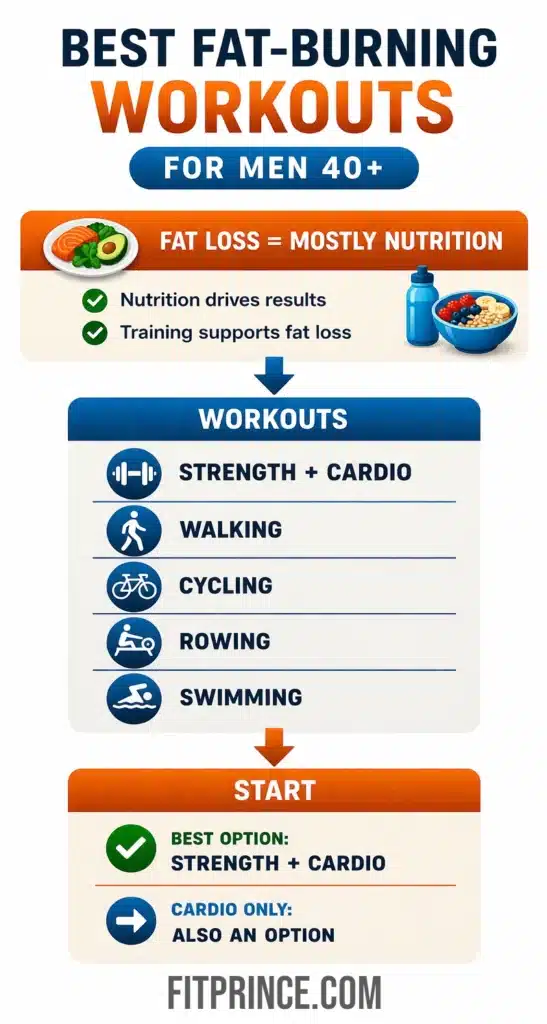
- 🍽️ Nutrition is the main driver of fat loss. Exercise speeds things up, but your diet decides how much fat you actually lose.
- 💪 In the very beginning, two strength workouts per week combined with regular walking or other light cardio are enough to start seeing early changes.
- 🚶 For some men, walking alone can be the foundation. Start slow and build up to 8,000–10,000 steps per day — it’s joint-friendly, boosts recovery, and keeps fat loss steady.
- 🚴 Besides the strength-and-cardio combo, other great low-impact options for men over 40 include cycling, rowing, and water-based workouts like swimming.
- 🧠 Choose something you enjoy and can stick with long term — that’s what keeps results coming.
- 🔁 What really matters is consistency. Small, regular efforts always beat random bursts of motivation.
Simple Overview
The 5 Most Effective Fat-Burning Workouts for Men Over 40
Before we break down the different training methods, it’s important to remember one thing.
If you need to lose a significant amount of fat, training alone won’t get you there.
Research shows that even with regular cardio — say, three sessions of 40–45 minutes per week — the average fat loss tends to be only around 2–5 kilograms (about 4–11 pounds) per year without any dietary changes. For some men, that’s a good start. But for others who want more noticeable body composition changes, training alone simply isn’t enough.
Over 80% of your results will come from nutrition — eating the right amount for your body and your age.
Workouts are the engine that supports that process: they help you keep muscle, boost your metabolism, and make fat loss easier to maintain.
Strength + Cardio — The Most Powerful Combo
The most effective way to lose fat, stay in shape, and protect your health after 40 is by combining strength training with cardio.
Strength training helps you keep — or even build — muscle. Muscle tissue burns a lot of energy, so the more muscle you have, the faster your metabolism and the easier it becomes to burn fat, even at rest.
Cardio, on the other hand, burns extra calories while you train and keeps your heart strong.
Plus, after both types of workouts — especially resistance training — you get the afterburn effect (EPOC), where your body continues burning calories for hours after you’re done.
Put it all together, and this combo turns your body into a real fat-burning machine.
Where to Start
If you’re just beginning, don’t worry about setting strict minimums.
Start with what you can realistically manage — even one workout per week is enough to begin. It won’t melt fat right away, but it helps you build the habit, which is the real foundation for long-term progress.
Once your body adapts, aim for:
- 2 strength workouts + 2 cardio sessions per week, or
- 2 strength workouts + 1 main cardio session + regular daily activity (stairs, yard work, active time with family, etc.)
That’s the minimum level where most men start seeing visible results.
Later, when recovery and energy improve, move toward 2–3 strength sessions and 2–3 cardio workouts per week.
Combining Both
Ideally, strength training and cardio should be done on separate days. That is usually the better option for recovery, performance, and long-term joint comfort.
Doing both on the same day should not be your regular plan unless your schedule leaves you no better choice. In most cases, it is less productive and can make recovery harder, especially for men over 40.
When separate days are not possible, try to leave at least 5–6 hours between sessions.
If you have to do both back-to-back, start with what matters most. For most men, that means strength training first and cardio second.
For example, years ago, before my 40s, when I wanted to lose extra fat, I often did 50–60 minutes of strength training followed immediately by 30 minutes of cycling. It worked in the short term, but over time it was not a great approach for muscle recovery.
Separate sessions usually give better overall results and place less stress on your joints.
Strength Training Basics
We already cover strength training in detail elsewhere on this site, but here are the basics:
- Train all major muscle groups evenly
- Choose joint-friendly exercises
- Duration: 30–60 minutes (not counting warm-up or cool-down)
- 8–15 repetitions per exercise
- 1–3 minutes rest between sets
- Focus on proper technique
- Always warm up and cool down
If time is tight at the beginning, don’t worry — even short 10–15-minute home sessions are better than skipping workouts altogether.
Think of these as your starter sessions, not your goal.
As you build consistency and confidence, gradually work toward full, balanced strength workouts lasting 30–60 minutes — these give the best results for men over 40.
Cardio Guidelines
Start with light to moderate, low-impact cardio — walking, cycling, or swimming. Do about 10–15 minutes per session at first and slowly build up to 30–45 minutes. In the beginning, your regular daily walking also counts toward your cardio total — the point is simply to move more.
As your fitness improves, try to reach these weekly targets:
- 150–300 minutes of moderate activity, or
- 75–150 minutes of more intense cardio, or
- a mix — for example, 100 minutes moderate + 50 minutes moderate/intense.
These are general recommendations from major health organizations. Use them as a guide, not a rule. Adjust everything to your own fitness level, recovery speed, and how your body feels day to day.
If your health allows, increase duration and intensity slowly. You’ll get more out of it by staying consistent — not by rushing.
How to Gauge Cardio Intensity
Training at the right intensity helps your body burn fat more efficiently. The ideal fat-burning zone is usually around 60–70% of your maximum heart rate (Zone 2).
How to find it:
- A laboratory fitness test is the most accurate way to identify your ideal heart rate zones, especially if you want precise targets
- Most smartwatches or fitness bands show it automatically
- You can also use an AI tool to estimate it
- Or use the manual formula: 208 − (0.7 × age), then take 60–70% of that number
→ For a 45-year-old man, that’s roughly 106–124 beats per minute - You can also use the talk test — you should be able to talk but not sing during cardio
HIIT (High-Intensity Interval Training)
Once your conditioning and overall health are solid, you can include HIIT as an advanced option.
HIIT alternates short, intense bursts of effort (about 80–90% of max, Zones 4 and 5) with easier recovery periods (around 50–60%, Zones 1 and 2).
Examples:
- Beginners: 20–30 seconds of hard cycling + 90 seconds easy
- Advanced: 30–60 seconds hard + 30–60 seconds easy
Total time: 10–20 minutes, depending on your fitness level. HIIT works best on low-impact machines like bikes or rowers and should be added only when your body is ready and recovery is stable.
It’s demanding — but it’s also excellent for improving power, stamina, fat-burning, and overall vitality as you age.
If, for any reason, you don’t want to combine strength and cardio — which I strongly recommend you do — that’s still fine. In that case, the next four cardio workouts below are the best options for men over 40 to burn fat, improve heart health, and protect the joints.
Walking — The Most Underrated Fat-Burner
Our ancestors — hunters and gatherers — used to walk 10,000 to 18,000 steps a day. That was normal life.
These days, most of us barely reach a fraction of that goal. Yet walking remains one of the most natural, joint-friendly, and accessible ways to burn fat — especially for men over 40. It can even serve as your main form of exercise if other workouts feel too demanding at the moment.
You don’t need fancy equipment or a gym — just a good pair of shoes and a bit of consistency.
How to Start
If you spend most of your day sitting — at a desk, in the car, or at home — don’t jump into long walks right away.
Start small.
Begin with 10–15 minutes a day and slowly build up to 30–60 minutes daily. That’s enough to start noticing improvements in energy, recovery, testosterone support, and weight control.
However, keep in mind — if walking isn’t paired with a good diet, fat loss will be minimal, around 0.05 kg (≈0.1 lb) per week.
Aim for 8,000–10,000 steps per day. You don’t have to do them all at once — walking to work, during lunch, or on your way home all count toward your daily total. Health benefits start even as low as 3,000 steps and continue to improve beyond that.
Progress Over Time
Once your daily 30–60 minutes feel easy, gently raise the challenge.
As your body adapts, what started as a light cardio workout will naturally turn into recreational activity — so keep adding small progressions over time.
- Add a hill or treadmill incline
- Walk on sand or uneven terrain
- Try brisk walking — you should be able to talk but not sing
You don’t need to chase speed — the goal is consistency. If you overdo it, your joints will remind you. Build up gradually and stay regular — that’s where real progress happens.
Choose the Right Gear
Good shoes matter more than you think.
If you plan to walk regularly, invest in a pair designed for walking or light running — with proper arch support and cushioning. The right footwear can prevent pain and make the whole process much more enjoyable.
And if you’ve had issues with your feet or knees before, consider orthopedic insoles and get your gait checked by a professional. Also, try walking on softer surfaces like grass or trails.
Nordic Walking (With Poles)
If you want to take walking to the next level, Nordic walking is an excellent option.
Using poles engages your upper body, improves posture, and slightly reduces pressure on knees and ankles.
For men who’ve had joint issues or long sedentary years, it’s a great low-impact workout — and it burns slightly more calories than regular walking.
The key is technique — don’t just grab poles and go. Learn proper form (there are great tutorials online), or join a local group. Good form prevents shoulder and elbow strain.
The only downside?
Men with shoulder problems might find the pole motion uncomfortable.
Otherwise, it’s one of the best all-around endurance activities you can do outdoors — simple, cheap, and joint-friendly.
Cycling — Burn Fat and Build Strong Legs
Cycling is another great low-impact workout — easy on your joints but powerful for your heart and fat loss. It also improves leg strength, balance, and overall endurance — things that matter a lot more as you get older. Plus, being outdoors gives that extra mental lift — fresh air, movement, and time away from screens.
How to Start
If it’s been years since you’ve been on a bike, start small.
Start with 15–20 minutes, 2–3 times a week, then build up to 30–60 minutes, 3–5 times a week. That’s enough to start noticing better stamina, stronger legs, and a tighter midsection.
Remember — your knees and hips will thank you if you build up gradually. Cycling is easier on the joints than running, but overdoing it too soon can still backfire.
Choosing the Right Bike
Pick a bike that fits your body and comfort level — that’s key.
If balance feels tricky, go for a bike with wider tires — or even a hybrid or city bike for extra stability. Make sure it’s not too heavy to move around, especially if you’ll need to carry it up stairs or lift it into the car.
Always wear a helmet and something reflective — especially if you’re riding near traffic or in low light.
Safety first, even for short rides.
Indoor Option: Stationary Bike
If weather, traffic, or storage are issues — no problem.
A stationary bike (exercise bike) is a great alternative. You can ride anytime, in any weather, without worrying about cars, potholes, or finding a parking spot.
There are two main types:
- Upright bikes — feel more like a traditional ride
- Recumbent bikes — lower and more comfortable, perfect if you have balance or joint issues
Choose what fits your body best and keeps you consistent.
How to Increase Intensity
Once you’re consistent, you can make it more challenging:
- Add a few minutes each week until you reach an hour
- On a real bike: ride slightly uphill or pedal faster for short bursts
- On a stationary bike: increase resistance or use preset programs
The key is to listen to your body — don’t rush.
Your heart, lungs, and joints will adapt better if you go step by step.
Pro Tip: Adjust Your Seat Right
A small but important thing — your seat height.
Make sure when the pedal is at the lowest point, your knee stays slightly bent (not fully locked). That’s how you protect your knees and keep the motion smooth.
Things to Keep in Mind
Cycling isn’t as plug-and-play as walking — you need space, a safe route, and a place to store the bike. There’s also the cost of gear and occasional maintenance. But if you enjoy it, it’s one of the best long-term ways to stay lean, strong, and mobile.
Rowing Machine – Full-Body Cardio
Another great low-impact option is the rowing machine — gentle on your joints but surprisingly strong for your heart, muscles, and overall conditioning. Unlike walking or cycling, rowing trains both your upper and lower body. About 65–75% of the effort comes from your legs, while your back, arms, and core handle the rest. That means you’re not just improving endurance — you’re also building full-body power and muscle tone at the same time.
Just like any other form of cardio, rowing alone won’t melt fat unless your diet is on point. However, it can fire up your energy for the day and help you build a stronger, leaner body.
Here’s a complete explanation of the best way to lose fat after 40 without losing muscle.
How to Start
If you haven’t rowed in years (or ever), start slow.
Begin with 10–15 minutes, 2–3 times per week. As your stamina improves, build up to 25–30 minutes per session, 3–5 times per week. Around 30 minutes of steady rowing is already a solid, fat-burning workout.
Because rowing uses more muscle groups than cycling or walking, even shorter sessions can feel intense — and that’s perfectly fine. Think quality over duration.
Technique Matters
Rowing isn’t just “sit and pull.”
To stay safe and get results, focus on proper form — that’s what protects your back and joints. Follow the correct motion sequence: legs → core → arms, then reverse it on the way back.
You can easily watch a few short tutorials on YouTube, film yourself from the side, and compare.
Or, if you’re new, ask a trainer to show you the basics once — it’s simple but worth it.
Poor form and going too hard too soon are the main reasons for lower back discomfort. Start easy, keep your movements smooth and controlled, and increase resistance gradually as you adapt.
Things to Keep in Mind
Rowing machines come in several types — air, magnetic, and water. They also differ in seat design, handle position, and leg support. Some models may suit your body better than others, so it’s smart to try before buying or at least watch detailed reviews.
You don’t need the most expensive rower — comfort, smooth motion, and noise level matter more.
If you plan to use it at home, make sure you have enough space and a stable floor. And place it somewhere you’ll actually use it — not hidden in the corner of the garage.
Swimming – Gentle on Joints, Tough on Fat
Swimming and other water-based workouts are another excellent low-impact option — very easy on your joints. Water supports your body weight, so your spine and knees get a break while your muscles still work hard against resistance. Almost every muscle group is engaged — legs, arms, back, chest, shoulders, and core — which is why swimming burns more calories per minute than walking, cycling, or rowing.
It’s especially great for men who carry extra weight or deal with joint stiffness or pain.
How to Start
If it’s been a while since you’ve swum regularly, start small.
Begin with 15–20 minutes, a couple of times per week.
If swimming laps feels too demanding at first, try water walking or gentle aqua movements — you’ll still get the benefits without overexerting yourself.
You can mix things up — swim slow laps, walk or jog in the pool, or try a short aqua-aerobics class. As your conditioning improves, increase the duration or swim more continuous laps.
Because water workouts use so many muscles at once, even shorter sessions can leave you pleasantly tired. Take breaks as needed and build up gradually.
Not confident in your technique yet?
Take a lesson with a swim coach — it’ll help you move more smoothly and protect your shoulders and neck.
Things to Keep in Mind
- Accessibility: Pool workouts aren’t always easy to access. Not every area has a nearby pool, and memberships can be costly compared to cycling or rowing.
- Increased appetite: Water workouts can make you hungrier — research shows swimmers often eat more afterward. Keep an eye on your calorie intake if fat loss is your main goal, or you might accidentally offset your progress.
Bottom Line
We’ve now covered five of the most effective ways to burn fat after 40 — strength plus cardio, walking, cycling, rowing, and swimming. Each has its own strengths, but the real secret isn’t which workout you choose — it’s whether you can stick with it long-term.
The best workout is the one you actually enjoy.
If it makes you feel good, fits your lifestyle, and helps you move consistently, you’ll get results. Training shouldn’t feel like punishment or endless calorie chasing. Focus on feeling stronger, moving better, and staying active for life.
Once again, remember — your diet does most of the fat-burning work. Exercise speeds up your progress, but nutrition determines how much fat you actually lose.
So don’t try to “outrun” a poor diet. Use workouts to build energy and discipline, and let food choices take care of the deficit.
If you’re just starting out and don’t know where to begin, the simplest and most effective combo is strength training plus walking.
👉 Don’t know where to start with strength training? This free beginner gym program for men 40+ will help you build a solid foundation.
Why Not Running (Yet)
Running can be great — but context matters.
If you’ve been inactive, carry extra weight, or haven’t trained in years, running might not be the best place to start.
For beginners over 40, running often puts unnecessary stress on the knees, hips, and lower back — particularly if you’re carrying extra weight. That’s why walking, swimming, cycling, or rowing are smarter early choices. They help you build a base of fitness without unnecessary joint stress.
Once your body has adapted — you’ve built up strength, endurance, and lost some weight — adding short, easy jogs can be a great progression.
Choose soft surfaces (grass, track, or trails), wear supportive shoes, and build up gradually.
So, it’s not about avoiding running forever. It’s about earning the right to run safely — when your body is ready.
How to Put It All Together (Weekly Plan)
Now that you know which workouts work best, the next step is to combine them in a way that fits real life.
Below are two simple examples — a minimal plan for busy weeks or beginners, and a stronger plan for those who are more experienced and can train more often.
Both are flexible. The exact days don’t matter as much as consistency.
Plan 1 – Minimal & Easy to Maintain
Monday: Strength training
Tuesday: Walking or other light cardio
Wednesday: Rest or walking
Thursday: Strength training
Friday: Walking or other light cardio
Saturday: Free movement (any outdoor activity)
Sunday: Rest or walking
Two strength sessions plus regular walking are enough to start noticing early results.
Plan 2 – Balanced & Stronger
Monday: Strength training
Tuesday: Cardio
Wednesday: Strength training
Thursday: Light activity
Friday: Strength training
Saturday: Cardio
Sunday: Recovery or light activity
Walk whenever possible throughout the day.
Final Tips
- If your schedule changes, shuffle the days — just keep the same balance between strength, cardio, and recovery
- Listen to your body — if you’re tired, lower intensity instead of skipping completely
- Progress comes from training regularly, not perfectly
If you need extra motivation to start training, learn more about the health risks linked to excess weight around the midsection after 40.
Frequently Asked Questions
Can I lose belly fat after 40?
Yes — absolutely. You can lose fat at 40, 50, or even later. Age itself isn’t the problem — lifestyle is. Fat loss happens when your body burns more energy than you eat. Combine a moderate calorie deficit with strength training and regular activity, and your body will respond.
Is fasted cardio better for fat loss?
Doing cardio on an empty stomach may burn slightly more fat during that session — but over time, results are usually the same. Why? Because people often eat more later in the day without noticing, which cancels out the short-term effect. So it’s not about when you train — it’s about your total daily calories.
How often should I train to start seeing progress?
To start seeing progress, aim for at least two strength workouts per week, plus regular walking or other light cardio on most days. You can also add one dedicated cardio workout each week for extra conditioning, and increase it gradually as your fitness improves. Remember — nutrition drives fat loss, while training speeds it up and helps preserve muscle.
Should I do HIIT after 40 to burn fat?
HIIT (High-Intensity Interval Training) can be a great addition — but only after you’ve built a fitness base. It’s demanding on the heart, muscles, and joints. If you’re new or returning after a break, focus first on walking, cycling, and light strength work.
Do supplements help with fat loss?
Some supplements can slightly support your progress (like caffeine or green tea extract), but they’re not magic. Nutrition comes first — no pill replaces a healthy diet and consistent training.
If you’re training hard and dieting but aren’t seeing results, these factors may be slowing fat loss after 40.
Your Next Steps
Fat loss after 40 doesn’t require brutal workouts or endless cardio.
The real progress comes from combining smart strength training, steady cardio, and daily movement — nothing extreme.
Start with what you can stick to: two strength sessions a week, regular walking, and a diet that supports your goals. Once that becomes routine, build from there.
The goal isn’t just to burn fat — it’s to move better, feel stronger, and stay lean for life.
References
View sources (11)
- A Meta-Analysis of Pedometer-Based Walking Interventions and Weight Loss.
https://pmc.ncbi.nlm.nih.gov/articles/PMC2203404/ - Aerobic Exercise and Weight Loss in Adults: A Systematic Review and Dose-Response Meta-Analysis.
https://jamanetwork.com/journals/jamanetworkopen/fullarticle/2828487 - Association of daily step count and serum testosterone among men in the United States.
https://pmc.ncbi.nlm.nih.gov/articles/PMC8159788/ - Cycling as an Older Adult: What to Consider.
https://www.healthline.com/health/medicare/cycling-for-older-adults - Daily steps and all-cause mortality: An umbrella review and meta-analysis.
https://www.sciencedirect.com/science/article/pii/S0091743524002020 - Effect of exercise training on weight loss, body composition changes, and weight maintenance in adults with overweight or obesity: An overview of 12 systematic reviews and 149 studies.
https://onlinelibrary.wiley.com/doi/10.1111/obr.13256 - Effects of water aerobics on body composition in obesity and overweight people: a systematic review and meta-analysis.
https://bmjopen.bmj.com/content/15/3/e091743 - Influence of water-based exercise on energy intake, appetite, and appetite-related hormones in adults: A systematic review and meta-analysis.
https://www.sciencedirect.com/science/article/pii/S0195666322004664 - The Benefits of a Rowing Machine.
https://www.healthline.com/health/benefits-of-rowing-machine - The Benefits of Stationary Biking.
https://www.arthritis.org/health-wellness/healthy-living/physical-activity/other-activities/benefits-of-stationary-biking - The Effects of Combined Aquatic Exercise on Physical Performance and Metabolic Indices in Overweight Healthy Older Adults.
https://pmc.ncbi.nlm.nih.gov/articles/PMC10824309/